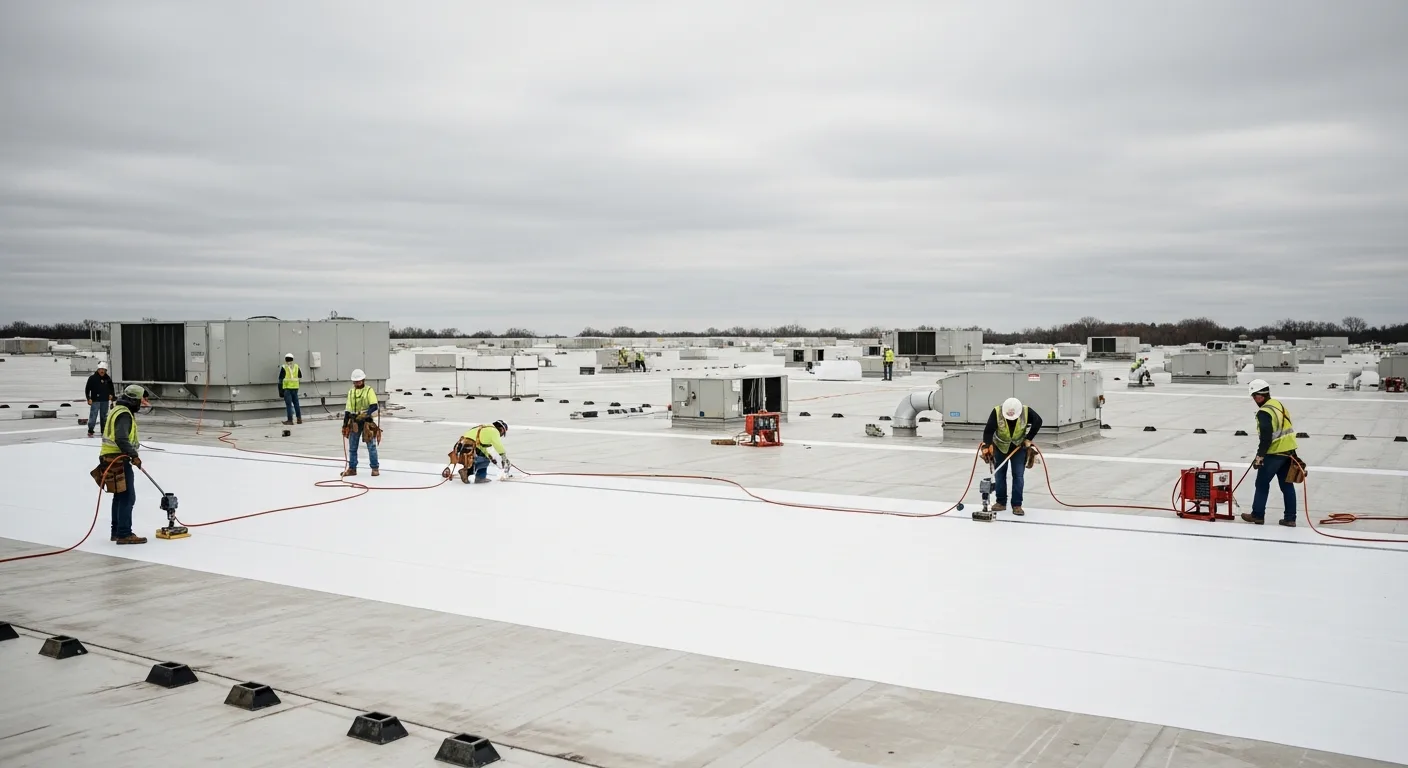
Emergency Commercial Roof Repair
Request service for active leaks during a storm, water entering a commercial building, ponding water concerns, and other emergency commercial roofing situations requiring same-day or next-day response.

A 24/7 commercial-only service request line for warehouse, distribution, manufacturing, retail, multifamily, and commercial property roofing across the Indianapolis metro — for active leaks, hail and storm damage, ponding water, planned repairs, and full roof replacement projects on TPO, EPDM, modified bitumen, PVC, metal, and SPF systems.
Commercial Properties Only · Indianapolis Metro · Flat Roof, TPO, EPDM, Modified Bitumen · Storm Damage & Emergency Leaks
Service Filter
Be in the right place before you spend any more time.
If you operate a commercial or industrial property in the Indianapolis metro and have a roofing problem, you are in the right place. If you are a homeowner with a residential roof issue, please contact a residential roofing company instead.
Services
Eight categories of commercial roofing service requests routed to a local commercial roofing provider when one is available and the request fits.
Request service for active leaks during a storm, water entering a commercial building, ponding water concerns, and other emergency commercial roofing situations requiring same-day or next-day response.
Request service for single-ply TPO and PVC membrane repair including seam failures, punctures, flashing failures, and weather-related damage on commercial flat and low-slope roofs.
Request service for EPDM rubber membrane repair including seam separation, punctures, flashing detail repair, and weather-related damage on commercial low-slope roofs.
Request service for modified bitumen (mod-bit) and built-up roofing (BUR) repair including seam failures, blistering, flashing repair, and surface restoration.
Request service for standing seam, R-panel, and other commercial metal roof systems including fastener replacement, seam sealing, panel repair, and coating systems.
Request service for commercial roof storm damage assessment, emergency tarp and temporary repair, insurance claim documentation, and permanent repair coordination.
Request service for full commercial roof replacement projects across TPO, EPDM, modified bitumen, PVC, metal, and SPF systems with manufacturer warranty support.
Request service for annual commercial roof inspections, semi-annual maintenance programs, and pre-warranty inspections for commercial property owners and portfolio managers.
Commercial only · Indianapolis metro · Provider details confirmed before dispatch
Service Area
Active coverage across the Indianapolis metro for commercial roofing service requests. Availability depends on provider capacity, equipment type, urgency, location, and facility-specific requirements — confirmed before dispatch.
Operating a commercial facility outside this list? Call for a service-area review — coverage adapts to provider capacity and job specifics.
Where the Work Happens
Six concentrations of commercial roofing demand across the Indianapolis metro — from logistics warehouses on the west side to manufacturing in the south and corporate campuses to the north.
The FedEx hub area, the AmeriPlex Indianapolis park, and the surrounding distribution facilities along Plainfield Road and Six Points Road — large-format low-slope warehouse roofing, with TPO and EPDM membrane systems dominant across the corridor.
Major distribution warehouses serving Walmart, Amazon, and grocery distribution networks. Large commercial flat roof installations and ongoing service across some of the largest single-building footprints in the metro.
Fast-growing logistics corridor with substantial new Class A warehouse construction. Mostly TPO single-ply membrane systems on large-format low-slope buildings, with active expansion through Boone County.
Office buildings, mixed-use commercial properties, hotels, and downtown commercial real estate with a mix of flat roof, modified bitumen, and historic roofing systems requiring careful detail work.
Established and growing office parks, mid-rise commercial buildings, and corporate campuses across Hamilton County. Single-ply membrane systems are common, alongside legacy modified bitumen on older buildings.
Manufacturing facilities, light industrial properties, and automotive supply chain buildings across the southside and westside metro. Production roofs where uptime and weatherproofing are operational priorities.
Why This Service Line
Built around how commercial property managers, facilities directors, and portfolio operators actually use a roofing service line — under deadline, with a building underneath that needs to keep operating.
This service line is exclusively for commercial and industrial roofing — warehouses, distribution centers, manufacturing, retail, multifamily, office, healthcare, schools, and other commercial property roofing. No residential shingle work is handled through this line.
Provider network is familiar with commercial property insurance documentation, claim filing support, and post-storm damage assessment. After hail or wind events, the dispatched provider can coordinate the documentation a commercial insurance claim typically requires.
Service requests are reviewed for service-area fit, roof system expertise, urgency, and manufacturer certification requirements before a provider is dispatched. This avoids sending the wrong crew to the wrong roof system.
Before dispatch, you can confirm who will perform the work, the expected arrival window, and the rate structure. Pricing is confirmed before work begins — no surprises after the truck shows up.
Many commercial roofing manufacturers offer installer certification programs that affect warranty eligibility. Documentation for specific manufacturer certifications held by the dispatched provider is available on request.
We are explicit about what this line does and doesn’t handle. No residential roofing, no DIY supplies, no residential gutter or siding work — so you reach the right service the first time.
Built For Commercial Operations
Eight commercial property categories that drive most of the service requests routed through this line.
Large-format low-slope warehouse roofing for distribution facilities where roof leaks can damage inventory, disrupt operations, and trigger tenant complaints across multi-million-square-foot footprints.
Production plants where roof leaks can damage equipment, disrupt manufacturing operations, and create safety hazards on the production floor.
Commercial retail properties with multiple tenant spaces where roof failures affect tenant occupancy, sales, and lease compliance obligations.
Single-tenant and multi-tenant office buildings where roof leaks affect occupants, IT and HVAC equipment, and tenant relationships.
Multifamily roofing for apartment complexes where roof failures affect resident comfort, lease compliance, and property reputation across multiple buildings.
Healthcare facility roofing where roof failures can affect patient care, sensitive equipment, and regulatory compliance obligations.
K-12 schools, university buildings, and institutional facilities with often complex roof systems requiring specialized commercial expertise and long-term maintenance planning.
REIT-owned properties, commercial property management portfolios, and multi-property commercial real estate where roofing service is needed across multiple buildings on coordinated schedules.
Process
A four-step intake and routing process. Provider identity, ETA, and rate structure confirmed before dispatch.
Call the line or submit the online request form. We collect property address, building type, roof system type if known, leak or damage description, urgency level, and contact information.
Helpful details include roof age, last service history, current symptoms, photos of leak location and roof if accessible, and tenant impact. The more context, the better the provider match.
Request reviewed for service-area fit, roof system expertise, urgency, and manufacturer certification requirements. Before dispatch you can confirm who will perform the work, ETA, rate structure, and documentation.
Provider performs the assessment, explains the repair path, confirms pricing before work begins, and provides documentation including any required manufacturer warranty records or insurance claim documentation.
Provider availability confirmed before dispatch · Indianapolis metro · Commercial only
Systems & Brands
TPO (thermoplastic polyolefin), EPDM (rubber), and PVC single-ply membrane systems — the dominant commercial low-slope roofing systems in the Indianapolis market, used on warehouses, distribution centers, manufacturing facilities, retail centers, and office buildings. Major manufacturers referenced include Carlisle SynTec, Firestone Building Products, GAF, Johns Manville, Sika Sarnafil, Versico, Mule-Hide, and IB Roof Systems.
Built-up roofing (BUR) with multiple plies of asphalt and reinforcing fabric, and modified bitumen (mod-bit) roofing with SBS or APP modifiers. Common on older commercial buildings, schools, and institutional facilities. Major manufacturers referenced include GAF, Johns Manville, CertainTeed, Siplast, and Soprema.
Standing seam metal roofing, R-panel roofing, and structural metal systems for commercial and industrial buildings. Spray polyurethane foam (SPF) for retrofit and energy-efficient applications. Coating systems for restoration and warranty extension. Major manufacturers referenced include Berridge, Englert, McElroy Metal, Carlisle Coatings & Waterproofing, GACO, and Henry Company.
Manufacturers Referenced
FAQ
Twelve substantive questions about how the commercial roofing service request line works, what’s covered, and what to expect before, during, and after dispatch.
No. This service request line is exclusively for commercial and industrial roofing — warehouses, distribution centers, manufacturing facilities, retail centers, office buildings, multifamily, healthcare, schools, and other commercial property roofing. Residential asphalt shingle roofs, residential gutter and skylight work, and single-family home roofing should be directed to a residential roofing company.
Call the service line immediately so the request can be routed to a provider with availability and the right equipment. While you wait, document the interior water damage with photos and video, place buckets and pull tarps over critical equipment or inventory if you can do so safely, and gather facility access information so the dispatched provider can move quickly on arrival. Do not access the roof yourself in active weather — slip and fall and electrical hazards on a wet commercial roof are serious.
Indianapolis Commercial Roof operates as a commercial roofing service request line. Service requests are routed to a local commercial roofing provider when one is available and the request fits the provider’s service area, equipment capability, schedule, and manufacturer certification requirements. Provider identity, licensing, insurance, and certifications are confirmed before dispatch.
Response time depends on provider availability, current weather, time of day, your facility location within the metro, and what equipment the job requires. After you call, the request is reviewed for fit and an estimated arrival window is confirmed before dispatch — that way you know what to expect rather than a generic SLA promise.
Active service-area coverage includes Indianapolis, Plainfield, Whitestown, Brownsburg, Avon, Mount Comfort, Greenfield, Greenwood, Franklin, Lebanon, Speedway, Beech Grove, Fishers, Carmel, Noblesville, and Westfield. Facilities outside this list are welcome to call for a service-area review — coverage depends on provider capacity and the specific job requirements.
Service requests are accepted for the full range of commercial low-slope and metal systems: TPO and PVC single-ply membranes, EPDM rubber membranes, modified bitumen and built-up roofing (BUR), commercial metal roof systems including standing seam and R-panel, and spray polyurethane foam (SPF). Provider expertise varies by system, and the service line confirms system fit before dispatch so the right crew arrives.
Yes — dispatched providers in the network can perform damage assessments, document conditions with photographs and reports, and provide written documentation to support insurance claim filing. Specific insurance documentation requirements (adjuster coordination, scope of damage reports, repair estimates, certified reports) should be discussed with the provider so the deliverable matches what your carrier needs.
Yes. Service requests are accepted for full commercial roof replacement projects across TPO, EPDM, modified bitumen, PVC, metal, and SPF systems. Larger replacement projects involve manufacturer warranty considerations, installer certification requirements, and project scheduling — all of which are confirmed during the provider fit step before any quote or contract.
Yes. Annual and semi-annual commercial roof inspection and maintenance program requests are routed the same way. PM programs typically cover inspection, debris and drain clearing, flashing and seam inspection, and small-repair items that prevent emergency leaks and protect manufacturer warranty compliance.
Provider licensing and insurance documentation is confirmed before dispatch. Commercial roofing typically requires general liability, workers’ compensation, and project-specific certificates of insurance (COI) — the dispatched provider can supply these on request and name your property entity as additional insured where required.
Many commercial roofing manufacturers — Carlisle SynTec, Firestone Building Products, GAF, Johns Manville, Sika Sarnafil, Versico, Mule-Hide and others — offer installer certification programs that affect full system warranty eligibility. Service partners in the network may hold various manufacturer certifications, and the specific certifications required for your project warranty can be confirmed with the dispatched provider before work begins.
Have ready: the property address and facility type (warehouse, retail, office, manufacturing, multifamily, etc.), the roof system if known (TPO, EPDM, modified bitumen, metal, etc.), the symptoms you’re seeing (active leak, ponding water, visible storm damage, seam separation), urgency level and any tenant or operations impact, on-site contact name and phone, and access details (gate code, after-hours contact, ladder or roof hatch location).
Request Service
Active leak. Storm damage. Ponding water. Planned repair. Replacement project. Inspection or maintenance program. The commercial roofing service request line is open 24/7 for Indianapolis-metro commercial properties. No residential roofing — commercial properties only.
24/7 commercial roofing emergency requests · Indianapolis metro · Provider details confirmed before dispatch
Or request service online →Indianapolis Commercial Roofing — Long Read
A single roof leak in a distribution warehouse can damage tens of thousands of dollars of inventory in hours. A leak in a retail center can disrupt tenant operations, trigger lease compliance issues, and put a property manager on a phone call with a frustrated regional director by the end of the day. A leak in a manufacturing facility can damage equipment, stop production, and cost more in lost output per shift than the permanent repair will cost in total. The math on emergency response versus delayed response on commercial roofing is unambiguous — a few thousand dollars in emergency dispatch is routinely the cheapest line item in a six-figure incident. This is why a 24/7 commercial roofing service request line exists separately from a residential contractor list: commercial roofing has a different urgency profile, a different documentation profile, and a different decision-maker on the other end of the phone.
Indianapolis weather drives a specific roofing demand cycle. Spring brings hail and high-wind events that punish commercial membrane roofs and metal panel systems. Summer thermal cycling stresses TPO and EPDM seams, especially on dark or older membranes. Late-summer and fall rains expose drain and scupper blockages that have been quietly building all year. Winter freeze-thaw cycles open up hairline failures in flashings, penetrations, and parapet details — and the first heavy spring rain finds every one of them. Central Indiana commercial roofing service requests follow this seasonal rhythm: emergency leak calls spike in spring, post-storm hail assessment calls cluster in late spring and summer, and planned-maintenance and inspection requests concentrate in fall. Knowing where the seasonal pressure is coming from is part of how requests get triaged when you call.
TPO seam failures show up as separations along welded laps, often where the original heat weld was cold or dirty. EPDM seam separations and shrinkage pull at penetrations and flashing details, especially on older fully-adhered systems. Modified bitumen blistering signals trapped moisture or substrate movement. Metal roof failures concentrate at fasteners, panel laps, and standing-seam details where coating or sealant has failed. Ponding water — defined by NRCA as water remaining 48+ hours after rain — accelerates membrane degradation and is one of the leading causes of premature commercial roof failure. Drain and scupper blockages from debris are the cheapest single failure to prevent and routinely the most expensive single failure to repair after the fact. When you call, describing the symptoms in this language helps the service line route to a provider with the right system expertise.
After a hail or wind event, the first 24–48 hours are critical for documentation. Commercial property insurance claims for roof damage typically require contractor assessment, photographic documentation of damage conditions, scope-of-damage reports, and coordination with the carrier’s adjuster. Wind damage requires distinct documentation from hail damage — wind claims typically focus on uplift, displaced flashings, and panel or membrane failures, while hail claims focus on bruising, fractures of the membrane surface, and impact marks on metal flashings and HVAC equipment. The dispatched provider can perform damage assessments and provide photographic documentation and reports to support claim filing. Specific insurance documentation requirements vary by carrier and should be discussed with the provider so the deliverable matches what your adjuster needs.
The repair-versus-replace decision on a commercial roof is rarely as clean as on a residential roof. Commercial roof replacement projects routinely run from $200,000 to over $2 million on large warehouse and distribution footprints, and the wrong call in either direction is expensive. A roof past its design life with multiple recurring leaks, deteriorated seams across the field, and saturated insulation usually belongs in a replacement budget rather than a repair budget. A roof with isolated mechanical damage, a single failed detail, or storm-specific damage usually belongs in repair with documentation. Manufacturer warranty status, insulation value, code-required uplift ratings, and roof-system compatibility with rooftop equipment all factor into the decision. Property managers should know whether the existing system is under warranty before approving any major repair — certain repair scopes void warranties if performed by non-certified installers.
Commercial roofing manufacturers — Carlisle SynTec, Firestone Building Products, GAF, Johns Manville, Sika Sarnafil, Versico, Mule-Hide, and others — operate installer certification programs that affect warranty eligibility. Full system warranties (membrane, insulation, accessories) often require certified installation by a contractor on the manufacturer’s approved list. Service partners in the provider network may hold various manufacturer certifications. For repair work that needs to preserve an existing manufacturer warranty — or for replacement projects where the warranty is part of the spec — the specific certifications required should be confirmed with the dispatched provider before scope is finalized.
Annual or semi-annual commercial roof inspection and maintenance programs are the single highest-leverage thing a property manager can do to prevent emergency leak calls and extend useful roof life. PM programs typically cover roof inspection, debris and drain cleaning, flashing inspection, seam inspection, and small-repair items addressed during the visit. Most manufacturer warranties on commercial roofs require evidence of regular maintenance to remain in force — so PM programs aren’t just risk reduction, they’re often a contractual obligation. Service requests for PM program enrollment are routed the same way as repair requests, with provider fit and scope confirmed before contract.
Service requests routed through this line cover Indianapolis proper, the high-volume distribution corridors in Plainfield and Whitestown, the I-70 East logistics zone through Mt. Comfort and Greenfield, downtown office and mixed-use properties, the Hamilton County corporate campus and office park belt across Carmel, Fishers, Noblesville, and Westfield, and the manufacturing and light industrial corridors across Greenwood, Franklin, Brownsburg, and Avon. Multi-property portfolios with buildings spread across the metro can request coordinated service across the portfolio in a single call.
Commercial properties only — no residential roofing. 24/7 emergency requests for commercial property managers, facilities directors, and commercial property owners across the Indianapolis metro.